

General information only. This article isn’t accounting, tax, legal or financial advice, and reading it doesn’t create a CPA–client relationship. Readers use it at their own discretion.
To compare houses, the listing price is only a starting point: two houses with similar prices can cost very different amounts to buy and to live in. The listing price leaves out closing costs, repairs, property taxes, insurance, HOA dues and the upgrades a buyer plans to add. Three numbers capture most of the difference between houses: the cash to move in, the monthly cost, and the all-in cost. This post shows how to compare houses with those three numbers, using three sample houses.
Why the Cheaper House Isn’t Always Cheaper
I built the Home Comparison Calculator because of a pattern: buyers often compare houses by price alone. Take two houses: one listed at $775,000 that needs $150,000 of renovation, some right away and some over the next few years, and a fully renovated one at $875,000. On price, the first looks $100,000 cheaper. With the renovation counted, it costs $925,000, which is $50,000 more than the renovated house, before the time and disruption of the work.
To me, taking the $775,000 house and its $150,000 of work only makes sense when it has something no renovation can add and no other house offers: the location, the school district, the lot or the view. Then the extra $50,000 buys something that can’t be found anywhere else, and the buyer pays it knowingly. Without a feature like that, the extra cost buys nothing the renovated house doesn’t already have. The Home Comparison Calculator puts that difference in plain numbers, so the trade-off is visible before making an offer.
The Three Sample Houses
Up to three houses, side by side
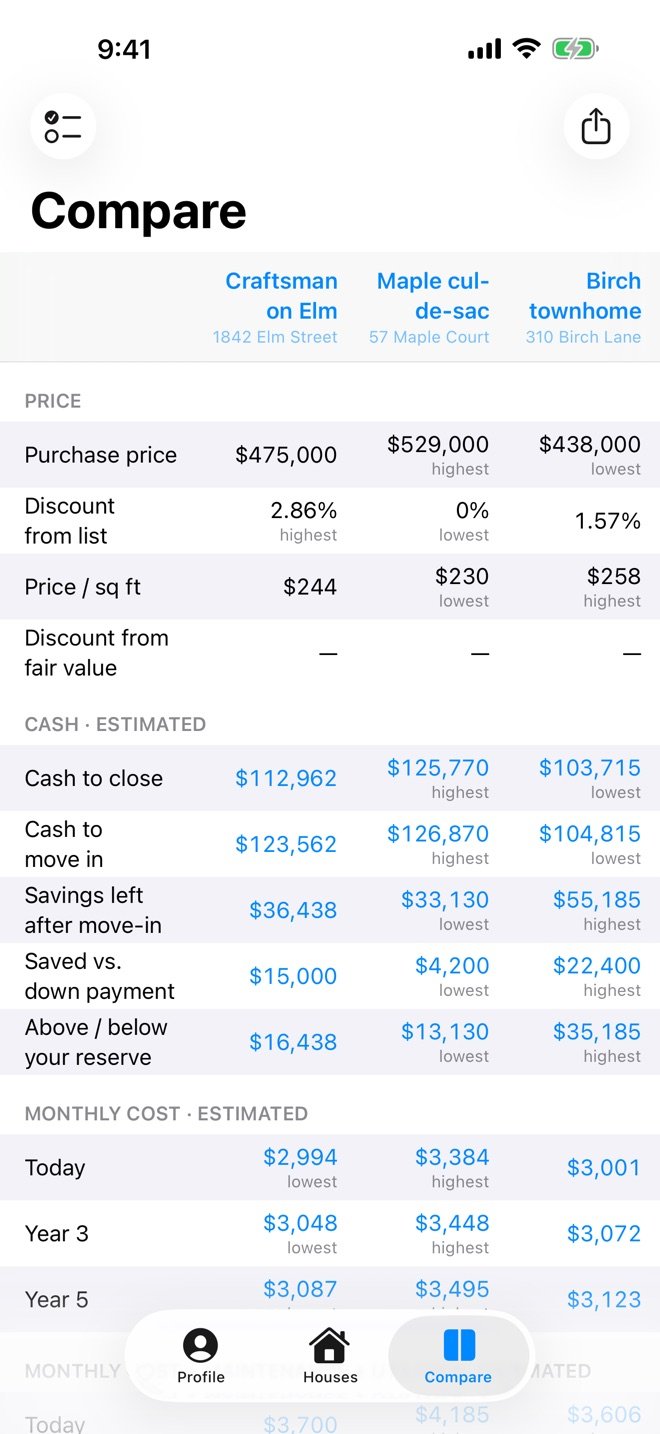
These houses are made up for this example (they’re the sample houses in the Home Comparison Calculator app).
| House | Craftsman on Elm | Maple cul-de-sac | Birch townhome |
|---|---|---|---|
| Purchase price | $475,000 | $529,000 | $438,000 |
| Square feet | 1,950 | 2,300 | 1,700 |
| Bedrooms / bathrooms | 3 / 2 | 4 / 2.5 | 3 / 2.5 |
| Year built | 1928 | 2004 | 2016 |
The example uses the same loan for each house: 20% down, a 30-year fixed-rate mortgage at 6.25%, and closing costs of 3% of the price. Actual rates and costs vary by lender and location.
1. Compare Houses by Cash to Move In
The cash to move in, line by line
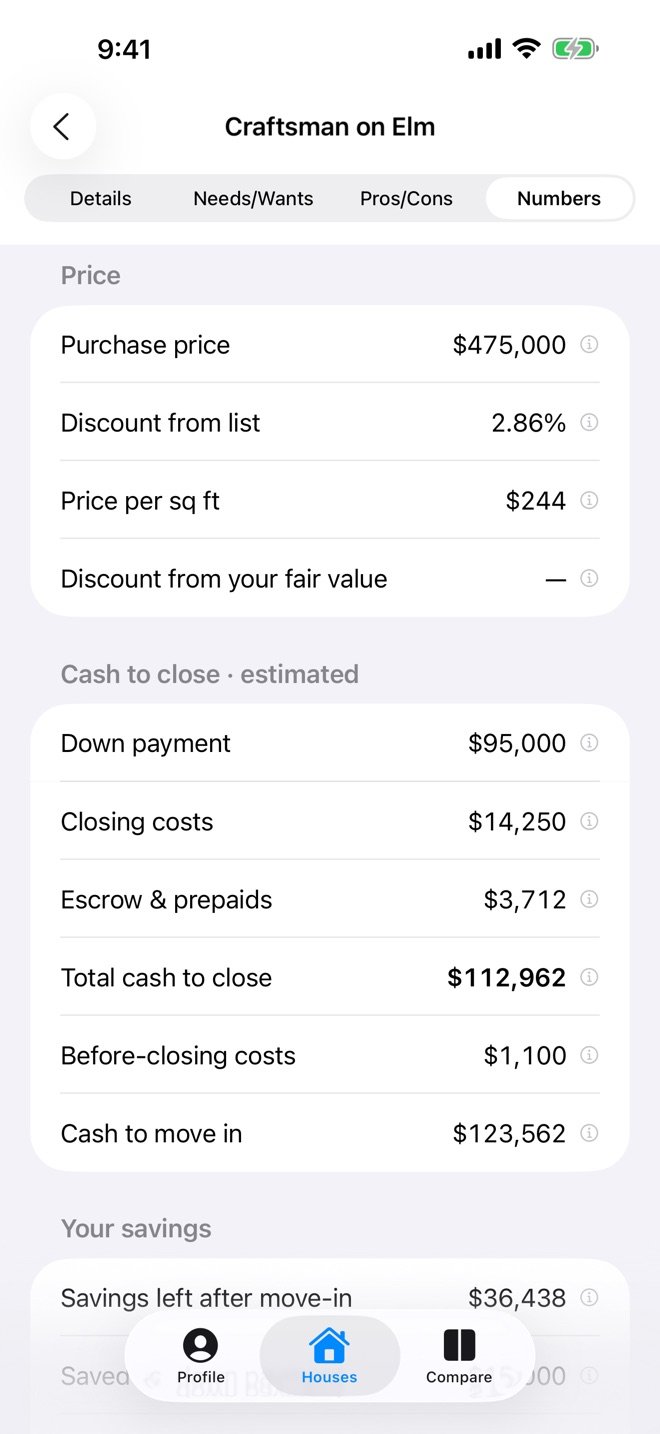
The cash to move in is the money needed before the keys change hands and the house is livable. For the Craftsman on Elm:
| Item | Amount |
|---|---|
| Down payment (20%) | $95,000 |
| Closing costs (3%) | $14,250 |
| Escrow and prepaid items | $3,712 |
| Cash to close | $112,962 |
| Costs before closing (inspection, appraisal) | $1,100 |
| Repairs needed before move-in (roof) | $9,500 |
| Cash to move in | $123,562 |
Earnest money is part of the down payment, paid early. A lender’s “Cash to Close” figure may be lower than this one, because it subtracts the earnest money already paid. The lender’s figure appears on the Closing Disclosure (see the Consumer Financial Protection Bureau’s explanation).
Across the three houses:
| House | Craftsman on Elm | Maple cul-de-sac | Birch townhome |
|---|---|---|---|
| Cash to close | $112,962 | $125,770 | $103,715 |
| Cash to move in | $123,562 | $126,870 | $104,815 |
The Craftsman’s price is $54,000 below the Maple cul-de-sac’s, but its cash to move in is only about $3,300 lower, because its roof has to be repaired before move-in.
2. Compare Houses by Monthly Cost, Today and Over Time
Every number, with its formula
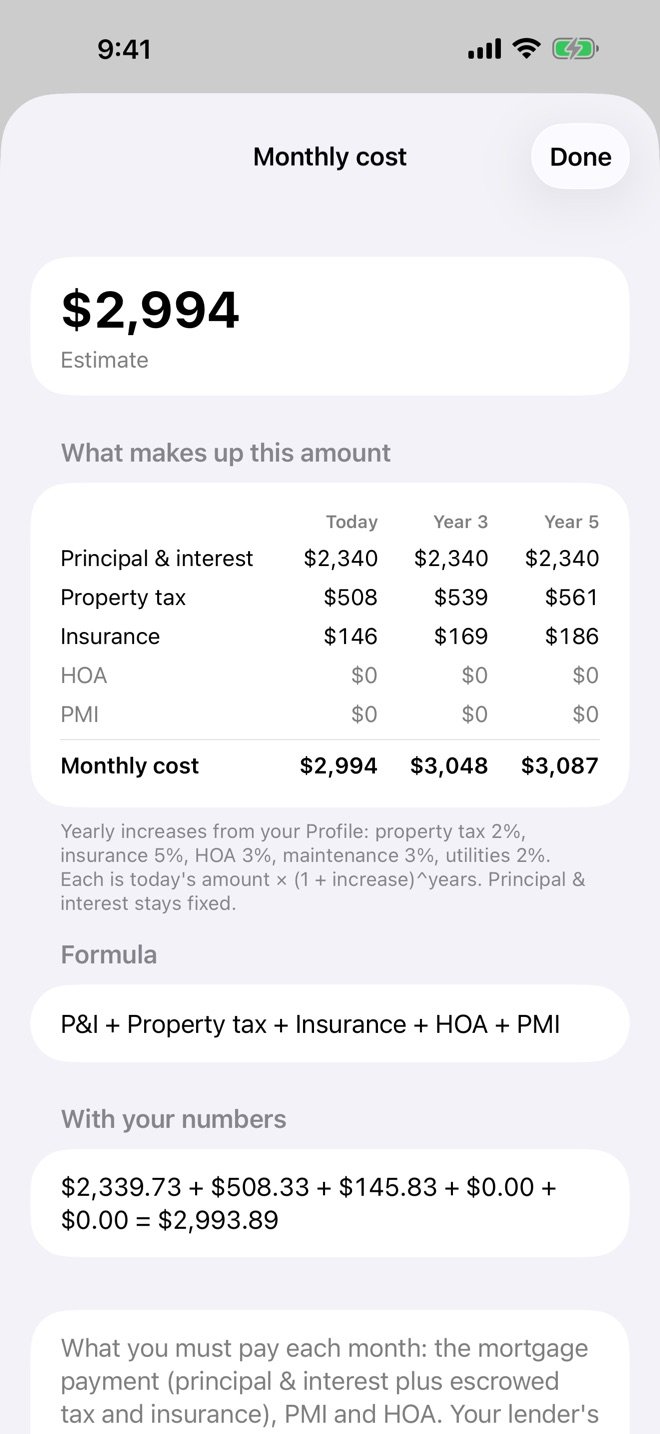
The monthly cost is principal and interest, property tax, homeowners insurance, HOA dues and private mortgage insurance (PMI). For the Craftsman: $2,340 principal and interest, $508 property tax and $146 insurance, a total of $2,994 a month.
With a fixed-rate mortgage, principal and interest stay the same, but property taxes, insurance and HOA dues usually rise. This example assumes yearly increases of 2% for property tax, 5% for insurance and 3% for HOA dues.
| Monthly cost | Craftsman on Elm | Maple cul-de-sac | Birch townhome |
|---|---|---|---|
| Today | $2,994 | $3,384 | $3,001 |
| In 3 years | $3,048 | $3,448 | $3,072 |
| In 5 years | $3,087 | $3,495 | $3,123 |
| Today, with maintenance and utilities | $3,700 | $4,185 | $3,606 |
The Birch townhome has the lowest price, but its monthly cost is slightly higher than the Craftsman’s today, because of its HOA dues, taxes and insurance. With maintenance and utilities added, it’s the lowest of the three.
Repairs: The Cost a Listing Price Doesn’t Show
Repairs and upgrades for each house
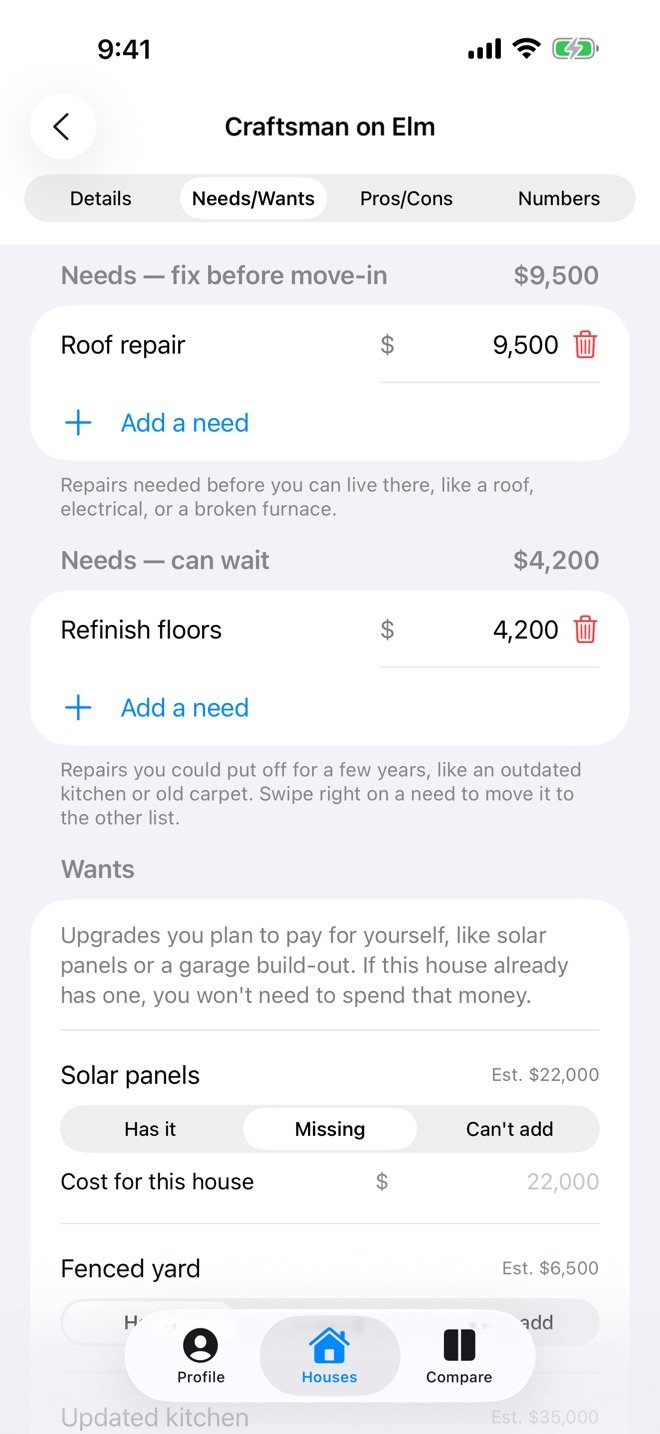
A house can look like the cheaper choice until the repairs are added in. During a showing, attention usually goes to the layout, the light and the neighborhood, and repairs are easy to set aside, even though they’re part of what the house costs. They usually show up in the home inspection report, and they fall into two groups:
- Repairs needed before move-in: things that have to be fixed before the house is livable, like a failing roof, unsafe electrical work or a broken furnace. These add to the cash needed up front.
- Repairs that can wait: things that can be put off for a few years, like an outdated kitchen, old carpet or worn floors. They don’t change the cash to move in, but they’re still part of the cost of the house.
Here is what that does to the three sample houses:
| House | Craftsman on Elm | Maple cul-de-sac | Birch townhome |
|---|---|---|---|
| Purchase price | $475,000 | $529,000 | $438,000 |
| Repairs before move-in | $9,500 (roof) | $0 | $0 |
| Repairs that can wait | $4,200 (floors) | $6,000 | $0 |
| Price + repairs | $488,700 | $535,000 | $438,000 |
On price alone, the Craftsman is $54,000 below the Maple cul-de-sac. With repairs, the gap is $46,300, and the Craftsman, built in 1928, needs its roof done before anyone moves in. The Birch townhome, built in 2016, has no repairs listed, so its price plus repairs is just its price.
In the Home Comparison Calculator, each house has two repair lists, “fix before move-in” and “can wait”, and both are added into the numbers automatically: repairs before move-in go into the cash to move in, and both kinds go into the all-in cost.
3. Compare Houses by All-In Cost
The all-in cost is the price plus every cost to buy: closing costs, escrow, costs before closing, repairs needed before move-in, and repairs that can wait a few years. Adding the “wants”, the upgrades a buyer plans to pay for (like solar panels or a fenced yard) that a house doesn’t already have, gives the total cost of the house the buyer actually wants. A want that can’t be added to a house (no room for a yard, for example) isn’t in that total.
| House | Craftsman on Elm | Maple cul-de-sac | Birch townhome |
|---|---|---|---|
| Repairs before move-in | $9,500 | $0 | $0 |
| Repairs that can wait | $4,200 | $6,000 | $0 |
| All-in cost | $507,762 | $556,070 | $455,215 |
| Wants to add | $58,800 | $36,800 | $1,800 |
| All-in + wants | $566,562 | $592,870 | $457,015 |
The Birch townhome already has the updated kitchen and is missing only the $1,800 EV charger. Solar panels and a fenced yard are marked “can’t add” there, so they aren’t in its total: its $457,015 is for a townhome without them. That’s why the gap with the Craftsman grows to about $109,500 once wants are included, compared with $37,000 on price alone, and why the two totals don’t describe the same house. The calculator counts the wants each house can’t add and shows them next to the numbers.
Beyond the Numbers
Pros, cons and deal-breakers
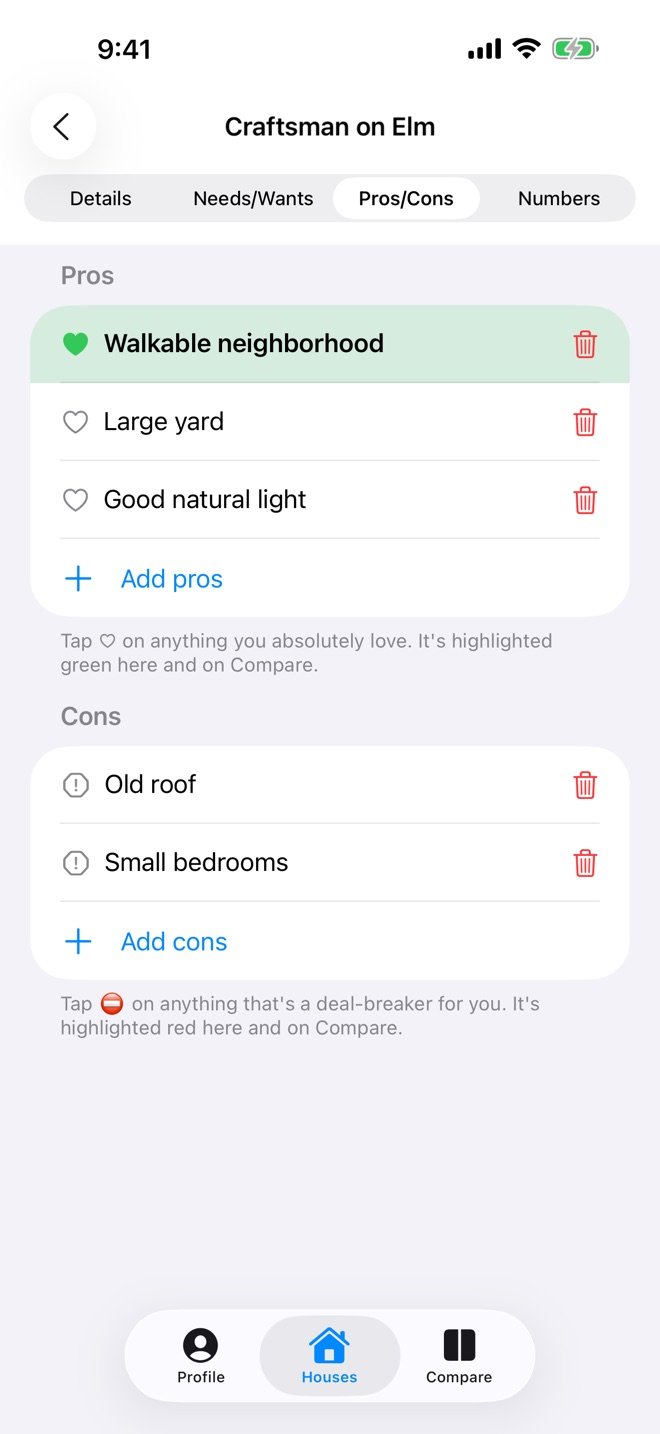
Numbers don’t capture everything. In the example, the Craftsman has a walkable neighborhood and an old roof, the Maple cul-de-sac is move-in ready with a long commute, and the Birch townhome is close to work but has road noise. A side-by-side list of pros and cons, with the must-haves and deal-breakers marked, sits next to the math.
Doing the Math
A PDF report to share
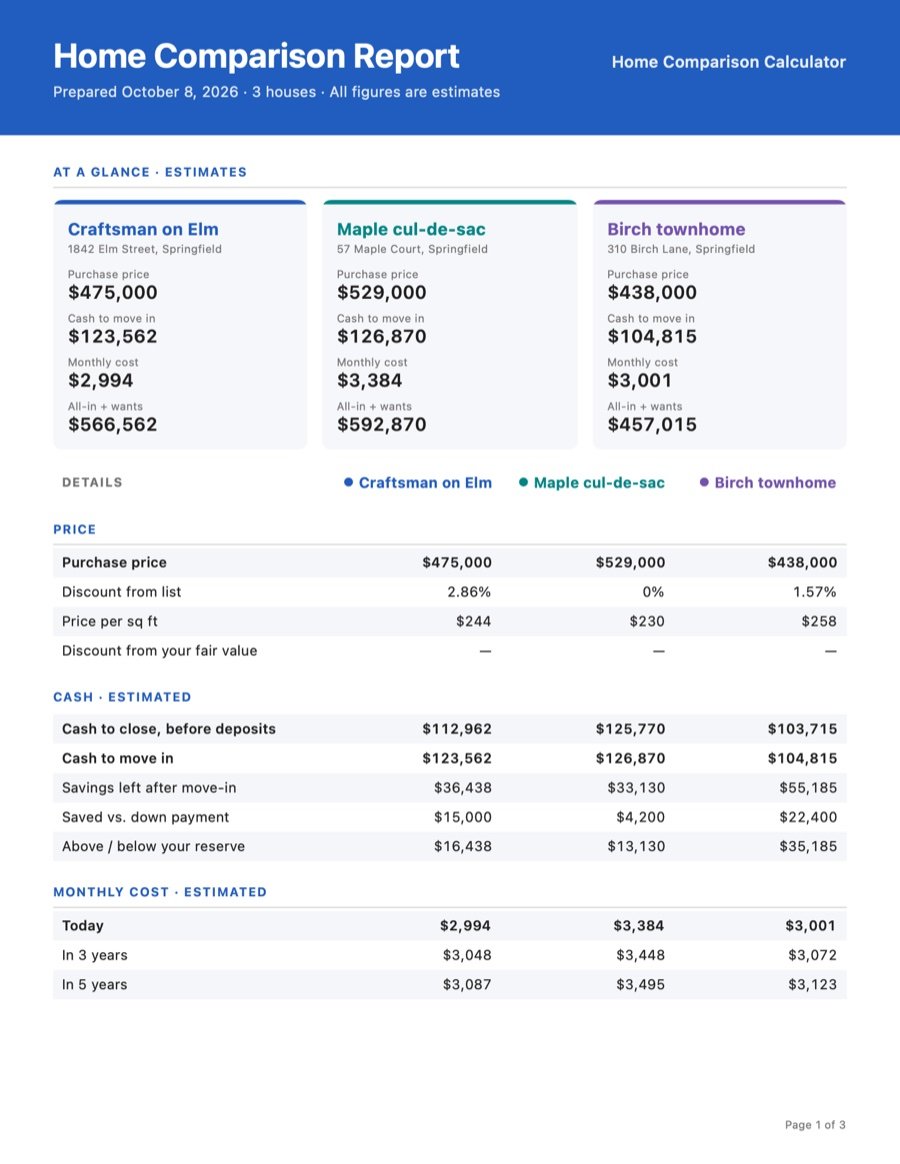
These numbers can be worked out in a spreadsheet, which makes it possible to compare houses before making an offer. The Home Comparison Calculator app does the same math for up to three houses side by side on iPhone and iPad (Android coming soon): cash to move in, monthly cost today and in 3 and 5 years, and all-in cost, with each formula shown when you tap a number. It also keeps pros and cons, repairs and wants for each house, and creates a PDF report to share. It’s free to try with two houses; a one-time $4.99 purchase unlocks unlimited houses, the full comparison and the PDF report.
More on the decision itself: Rent vs. Buy in 2026 and How Much Income Do You Need for a $1 Million Home?
Disclaimer: The houses and numbers in this post are examples, not offers or quotes. This post is general information, not financial, tax, legal or real estate advice. A lender, real estate agent, tax professional or attorney can confirm the numbers and terms for a specific home.